
Chasing Your Tail
Geriatric overmedication

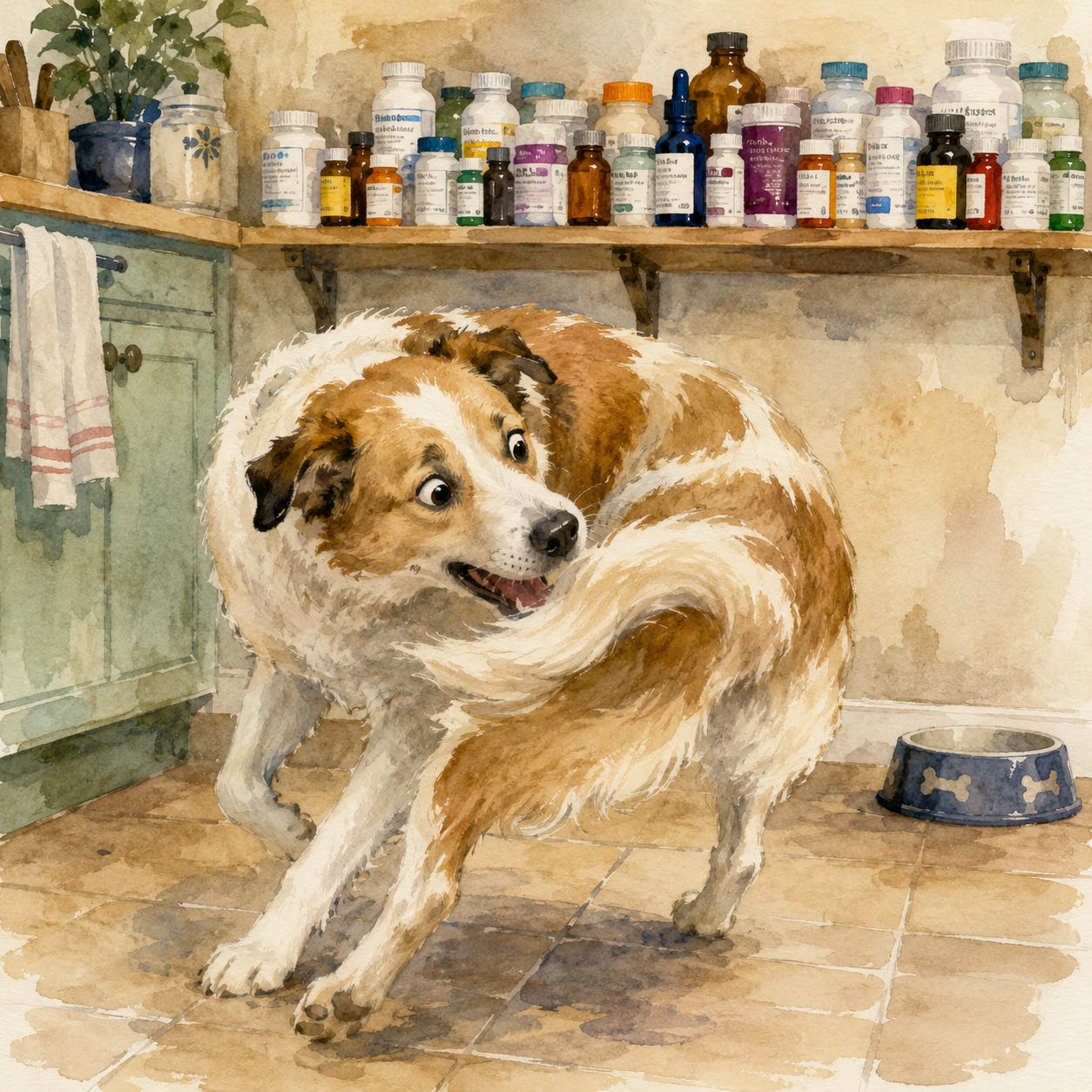
You have all witnessed this scene: your precious mutt, ears flapping, rear end in high gear, frantically orbiting his own hindquarters in hot pursuit of a tail that remarkably is attached to him. Philosophers have pondered the implications. I prefer to use it as a metaphor for modern American pharmaceutical practice.
My roommate of 56 years (bless her heart, and I mean this in the kindest way possible) finally conceded that one knee had reached its expiration date. She had fought a valiant rearguard action against the inevitable: a partial meniscectomy here, a joint cleanout there, the ritual steroid injections that are the orthopedic equivalent of putting a fresh coat of paint on a condemned building. But when the sound of bone grinding on bone began to disturb my sleep and alarm the neighbors as we strolled past their homes, she accepted that the time had come to submit to the knife.
Many of her former tennis partners, now pickleball devotees, as is the fashion among the bionic set, sport impressive collections of long leg scars and assured her it was not so bad. Her preferred surgeon, who commands a cult following in our 55-plus community rivaling only that of certain celebrity chefs, was booked for months. He recommended his partner, who had, conveniently, operated on his own parents. Such a recommendation carries the weight of a man who had literally put his people where his mouth was.
Once the die was cast, the medical bureaucracy lurched into motion. The protocol demanded the usual battery of lab tests and an ECG. The ECG, naturally, came back with an anomaly sufficient to threaten Monday’s surgery, discovered, of course, on Thursday afternoon. Every cardiologist within a 50-mile radius cheerfully offered her an appointment sometime in early 2027. Being a woman of resourcefulness (one does not survive 56 years of marriage without developing a certain talent for improvisation), she enlisted a pickleball companion to persuade her cardiologist to see her the next day. I, meanwhile, uploaded the ECG tracing to an AI program, which diagnosed it as a benign variant common in fit, active older patients. The human cardiologist arrived at the same conclusion the following morning and communicated to the surgeon via fax. Because this is 2026, and physicians’ offices are still apparently operating on the telecommunications infrastructure of the 1980s.
But the fax machine is not the point of this story. The surgery itself and the nursing care were genuinely excellent. No. The point is the medications.
Both of us are, by conviction, therapeutic nihilists. Our prescription list is blessedly brief; our supplement shelf is bare. We regard the American fondness for daily pill ingestion with the same detached anthropological curiosity one might bring to an exotic tribal ritual. It is interesting from a distance, baffling up close. My roommate, in particular, reacts to pharmaceuticals the way a Victorian novel’s heroine reacts to emotional distress: dramatically, comprehensively, and with symptoms not mentioned in any literature the prescribing physician has ever read.
So the post-operative medication list was a source of dismay.
First came the analgesics: oxycodone, an NSAID, and acetaminophen. A trifecta that addresses pain from three different biochemical angles, rather like sending three separate plumbers to fix the same leaky faucet. Then came the drugs to counteract the side effects of the first group. Then, with a certain grim inevitability, the drugs to manage the side effects of those. A stool softener to address the opioid-induced constipation. A proton-pump inhibitor to protect the stomach from the NSAID that was protecting the knee. An anti-nausea medication because, apparently, the cure for surgical trauma is nauseating. Each drug busily creates the conditions that necessitate the next, in a pharmacological relay race with no finish line.
The dog, tail forever out of reach, would have understood completely.
Here is where the satire shades into something more uncomfortable. My roommate’s post-surgical pharmacy bag, impressive as it was, is a modest weekend kit compared to the standing medicine cabinet of the average American over 70. According to data that should give any reasonable person pause, nearly 40 percent of adults over 65 take five or more prescription medications daily, a practice clinicians have given the technical name “polypharmacy,” which means exactly what it sounds like: a great many drugs, administered in chorus. Among those over 70, studies suggest the average number of daily medications hovers between five and seven, with a significant cohort managing ten or more. Ten.
One wonders how they have time for anything else.
The pharmaceutical industry, to its credit, has not overlooked this opportunity. Each new drug to treat the side effects of the previous drug represents not a problem but a revenue stream. Drug A causes Drug B, which necessitates Drug C. This is not a flaw in the system; it is, one suspects, more of a feature. The American healthcare model has achieved something the dog never could: it has actually caught its tail, monetized it, and is now selling subscriptions.
The side-effect profiles of these medications deserve a moment of hushed appreciation. The average television advertisement for a drug of modest benefit spends approximately eleven seconds describing the drug’s purpose and forty-nine seconds reciting its contraindications, at a pace suggesting the announcer has a personal stake in not being heard. Suicidal ideation as a side effect of an antidepressant. Stroke risk from a blood thinner intended to prevent stroke. A drug to combat osteoporosis that, in rare cases, causes the femur to snap spontaneously, which rather defeats the purpose.
The body, it turns out, is not a simple machine; it is a baroque ecosystem, and introducing any new chemical tends to rearrange the furniture in unpredictable ways.
The elderly are particularly susceptible to this biochemical cascade. Aging kidneys and livers clear drugs more slowly, meaning the drugs that were calibrated for a robust forty-five-year-old are circulating in a seventy-five-year-old at rather higher concentrations than anyone planned. Drug interactions multiply combinatorially: two drugs have one interaction profile; ten drugs have forty-five possible pairings. Nobody, not the prescribing internist, not the orthopedic surgeon, not the cardiologist who cleared my roommate by fax, is quite sure what all those combinations are doing at once. There is a specialty called geriatric pharmacology dedicated to this problem. It is, I imagine, a growth field.
My roommate is recovering, which we attribute entirely to her constitution and, despite her medications, two of which have already been quietly discontinued after she exhibited side effects that the prescribing physician described as “unusual or rare” and that she described, with her customary precision, as “intolerable.” We hope that soon the neighbors can once again sleep through our morning walks.
And somewhere, a dog is still chasing his tail, blissfully unaware that a pharmaceutical company has filed a patent on the concept.
A visit to the back of Sun City’s local Walgreens dramatically illustrates what you write about: almost every afternoon there are up to a dozen cars queuing at the drive up window waiting to pickup a prescription. This can’t be faster than walking in and the 100 foot round trip from the car to the instore pick up counter would like be good exercise for most of these drivers.
I hope your "room mate" is doing well. Send her my love and best wishes