
Dressing and Clothes in Texas
An Expanded Taxonomy of Jeans

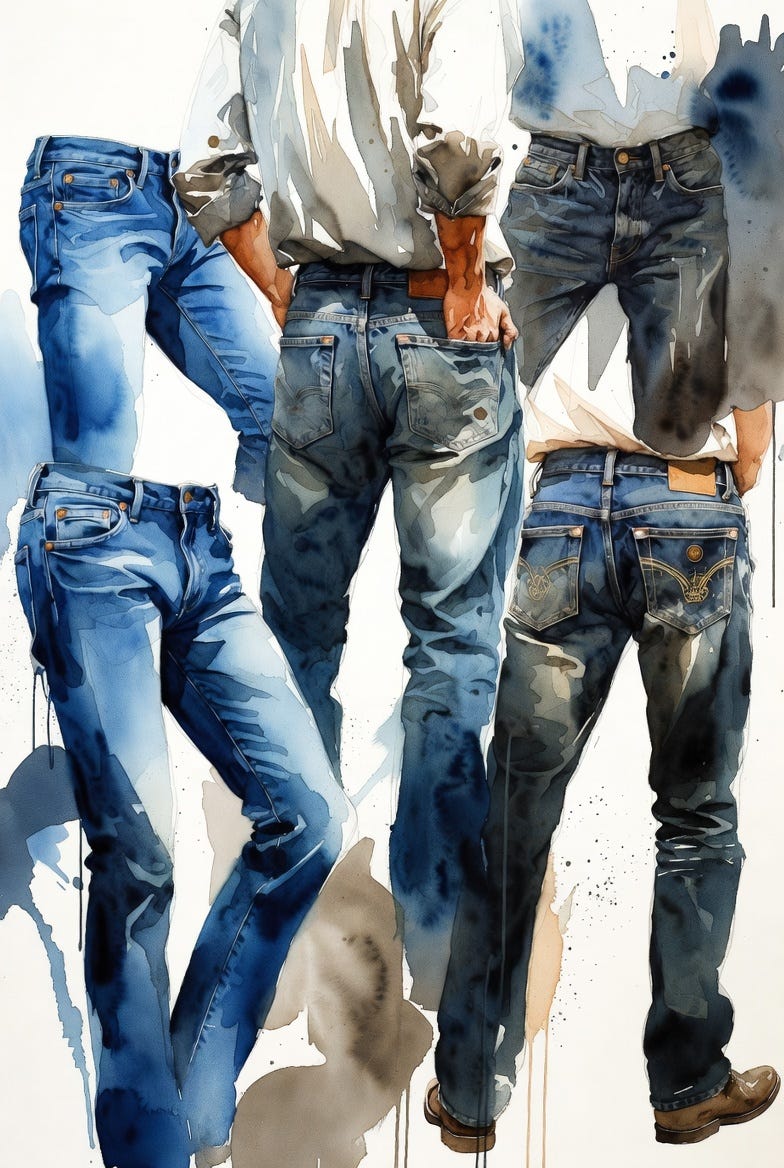
I am not a natty dresser. No one has ever accused me of dressing for success. And it shows. My wife, embarrassed by my general dishevelment, especially when the cuffs and collar are frayed and the socks visibly holey, tries hard to mitigate the problem, as she sees it. Now and then she brings home a wide selection of new clothing, lays it on the bed, and waits for me to choose. My selection lasts all of sixty seconds, and she returns the rejects to their respective stores. This has worked well for both of us. For a few months, she is less embarrassed with her consort, and I don’t waste time shopping. It has become a mutually symbiotic relationship we are both comfortable with.
In Seattle, my sartorial slovenliness went unnoticed. Some suspect that I was the poster child for the grunge movement. When I moved to Texas, I owned no suit, no tuxedo, and few ties. And the few I did own screamed their acquisition date to anyone who knew anything about fashion.
The expectations for personal appearance down here in Texas are unstated, but crystal clear. The idea that you are defined by how you look, how you speak, and what you do has supplanted the Northwest ethic: “I am what I am.” As there is no way I will ever learn to say it right, I have to concentrate on the other two – looking the part and doing the right thing. So I have been making a general study on appropriate dress. One can never go wrong with jeans as long as they are starched as stiff as a board. Be it a wedding, the opera, a funeral, or a simple visit to Walmart, a pair of clean, starched jeans will do, particularly black. These are the dress jeans. Other key elements of dress are well known to ya’ll – large belt buckles, a Stetson for every occasion, boots and a bolo tie, and a pale cream colored western style jacket.
As a neophyte in Texas dress, I was unaware of several facts known only to natives. Blue jeans come in numerous types and describe the owner/wearer with precision, revealing their family background for several generations, economic and educational status, future employability, credit score, religious denomination, BBQ preferences, and prospects as a future son-in-law — all from the choice of jeans.
Wrangler Jeans. Worn by those from West Texas, particularly from small towns, who aspire to be “cowboys” which means they wear black cowboy hats, have a western cut to their clothes, dip snuff (usually Copenhagen, though Skoal in a pinch), drive a pickup ‘hog truck’ with truck nuts dangling from the hitch, drink Lone Star long neck beer exclusively (Shiner Bock on special occasions), will not be going to college (unless you count the rodeo circuit as higher education), aspire for a double wide trailer house with a satellite dish bigger than the bedroom, and anticipate going to work for their uncle at the filling station or that cousin who does “something with oil rigs.” These young men are usually very skinny and can tolerate the tight legs and short crotch that go with those jeans. They know every verse of “Amarillo By Morning” and get misty-eyed during the national anthem at the rodeo.
Levi’s. Worn by town-boys, usually college graduates or at least college-adjacent, who have wider butts that need the more ample legroom of that brand. They typically wear Ivy League Polo dress shirts, plan to sell real estate or “get into tech” (which in Texas means working for a company that has a website), wear baseball hats (college team, never professional), drink Vodka tonics at happy hour and craft beer on weekends, and have college-educated parents who still mention their SAT scores at dinner parties. This difference between Wranglers and Levi’s is evident on any Friday night at any West Texas high school football game, where they sit on opposite sides of the bleachers and communicate through meaningful glares.
Designer Jeans. A matter of derision to true Texans. These are non-natives or newcomers playing the role of Texas Cool with all the authenticity of a theme park. Most are from California or other, slightly more acceptable Pacific Rim states, though we’re still suspicious. These folks drink Pink Margaritas (with the sugar rim), imported beer they can’t pronounce, smoke Cuban cigars while discussing cryptocurrency, live in fancy suburbs with names like “The Preserve at Eagle Ranch Estates,” are divorced at least twice (working on number three), and claim they have children in Ivy League schools. It’s actually a private school in Dallas with “Academy” in the name. They wear other designer clothes made by people whose name a Texan could not spell, or would want to admit they had ever heard of, plan to move on as soon as they make a million from their new job at whatever company is currently pretending to be the next big thing, and often have very ample butts and waists that they refer to as “dad bod” like it’s a positive attribute.
Cinch Jeans. The rancher aristocracy. These cost more than your car payment and are worn exclusively by people who own actual working ranches, not hobby ranches where Houston lawyers keep three photogenic longhorns. Cinch wearers drive $80,000 pickup trucks that have never seen mud, own land measured in sections, not acres, belong to the cattlemen’s association, donate to agricultural colleges, wear starched shirts even to breakfast, and can discuss beef futures and rainfall totals with equal passion. Their belt buckles are large enough to deflect small-caliber rounds and were won at legitimate rodeos, not purchased at Cavender’s. They drink bourbon, neat, and their families have been in Texas since before it was Texas.
Rustler Jeans (Walmart Brand). The honest workingman’s choice. These are worn by men who actually work for a living--welders, electricians, roughnecks, construction workers, mechanics. They’re practical, cheap enough to replace when destroyed by actual labor, and come pre-faded so the bleach stains don’t show. Rustler men drive trucks that are held together by duct tape and prayer, drink whatever beer is on sale, eat lunch from a cooler, have a favorite taco truck, can fix anything with baling wire and determination, and are generally the only people in Texas who actually know how to do useful things. Their wives think they’re handsome, and that’s all that matters.
Baggy-Assed Jeans. Indicate minority status, gang membership, and are associated with tattoos and “low riders.” Also worn by skateboarders, aspiring rappers, and teenage boys whose mothers have given up trying to make them pull up their pants. These young men communicate primarily through elaborate handshakes, hold strong opinions about sneaker brands, and will eventually grow out of this phase to become insurance adjusters who still listen to the same music they did in high school, just at a lower volume.
Black Skinny Jeans. The Austin invasion. These are worn by transplants who moved to Austin for SXSW in 2009 and never left. They work in “creative fields” (barista, freelance graphic designer, Instagram influencer with 847 followers), have strong opinions about breakfast tacos vs. breakfast burritos, own fixed-gear bicycles, drink cold brew exclusively, use “summer” as a verb, have a screenplay they’re “working on,” sport carefully curated facial hair, and become absolutely insufferable during ACL Festival. They claim to remember when Austin was “weird” despite having arrived last Thursday. True Texans view them the way cowboys viewed homesteaders: inevitable, vaguely annoying, but ultimately harmless.
Colored Jeans (Red, Yellow, Pink, etc.). Indicate a true “town boy” who has never seen a cow and probably screamed when he encountered his first armadillo. These are worn by men who use product in their hair, know what “thread count” means, own more than two pairs of shoes, have opinions about brunch, can identify different types of lettuce, and whose idea of roughing it is a hotel without room service. They can vote in Texas, but only because the Supreme Court says we must allow them. If they venture to small towns, the other kids pick fights with them, their girlfriends leave them for Wrangler guys, and they flee back to their urban enclaves where people understand that salmon is a color, not just a fish.
Bootcut Jeans (circa 1997). Worn by men frozen in time, usually between the ages of 45 and 65, who peaked in high school and won’t let anyone forget it. They still have their letterman jacket, still tell the same stories about the big game, still date women who were cheerleaders in 1994, drink domestic light beer exclusively, have a garage full of tools they don’t know how to use, refer to their truck as “she,” follow high school football with religious fervor despite not having children in school anymore, and become district managers of regional sales territories. They are kind to waitresses, loyal friends, and genuinely believe the ‘90s were mankind’s golden age.
Raw Selvedge Denim. The denim snob. These jeans cost $400, have never been washed (something about “authentic fading” and “natural patina”), and are worn by men who moved to Texas for work but maintain that everywhere else is better. They’re usually from Portland or Brooklyn, work in tech or craft brewing, have strong opinions about coffee beans and vinyl records, drive Subarus with kayak racks, subscribe to multiple streaming services but claim they don’t watch TV, say “actually” at the start of most sentences, and perform elaborate mental gymnastics to explain why their pretentious denim obsession is somehow more authentic than a cowboy’s Wranglers. They will leave Texas within three years, citing the heat, but really, it’s because nobody wanted to discuss the fascinating history of Japanese denim mills.
Stretch Jeans (with Elastic). The dad surrender. Worn by men who have accepted their fate, stopped fighting their metabolism, and prioritized comfort over dignity. Usually paired with New Balance sneakers (the ultimate white flag of fashion), tucked-in polo shirts, and a cell phone belt clip. These men grill on Sundays, have strong opinions about lawn care, watch HGTV with their wives, take anniversary cruises, wear sunscreen, and are genuinely content. They’ve made peace with elastic waistbands and would like you to know these jeans are “actually quite comfortable” and “you should try them.”
Embroidered Pocket Jeans. Exclusively worn by women, but worth mentioning for completeness. These feature rhinestones, elaborate stitching, crosses, horseshoes, and enough bedazzlement to be visible from the International Space Station. Paired with oversized sunglasses, blonde highlights, and boots with more decorative stitching than a Fabergé egg. These women drive white SUVs, belong to multiple Bible study groups, have “Live Laugh Love” somewhere in their homes, drink wine called “Mommy Juice,” and their husbands wear either Cinch jeans or are in middle management wearing Levi’s. They are the true power structure of suburban Texas.
No Jeans At All (Slacks/Khakis). The ultimate outsider. These poor souls wear Dockers or dress slacks, have transferred from corporate headquarters in Connecticut, attend HOA meetings, complain about the lack of good delis, pronounce it “cue-pon” instead of “coo-pon,” don’t understand why school closes for the livestock show, have never been to a tailgate, think barbecue means hamburgers and hot dogs, and will be transferred again within 18 months, never having understood what they witnessed.
So there you have it. An entire life history--past, present, and probable future--just from the type of jeans. My grandmother always said you can judge a person by the clothes they wear, so remember to polish your boots before going out, and for heaven’s sake, starch those jeans until they can stand up on their own.
The true genius of Texas is that everyone knows this taxonomy, no one speaks of it directly, and violations are met not with correction but with a slight narrowing of the eyes and a story that begins, “Well, bless your heart...”
Doesn’t anyone wear Carhartt or Key Bibs in Texas? They are comfy in the heat with a tank top, or hoodie when it’s cold. Up here in the PNW, Carhartts are haute couture.
175 students in my medical school class, and I was the only undergrad sociology major .