
Medieval torture vs Multiple Choice
A dinosaur's guide to learning

A recent New York Times article by a prominent educator suggested we return to "medieval" examination methods to combat AI-assisted cheating in schools. Medieval? Apparently, anything that doesn't involve clicking A, B, C, or D now qualifies as a relic from the Dark Ages. By this logic, I'm a living dinosaur.
The modern educational crisis is ironic. We've spent decades perfecting the art of the take-home exam and online assessment, celebrating how "accessible" and "flexible" our educational system has become. Now ChatGPT has crashed the party like an uninvited guest, and suddenly we're clutching our pearls, wondering how students could possibly cheat when we've made it so incredibly easy to do so.
There are two battles being fought here. First, students genuinely need to learn how to harness AI as a tool—like learning to use a calculator without forgetting basic math, except the calculator now writes poetry, solves complex equations, and occasionally lies with the confidence of a politician. That is not what keeps me up at night.
The second battle is the real problem: How do we actually assess whether students have learned anything, or if they've simply mastered the fine art of prompt engineering? The answer, according to the NYT piece, is beautifully simple and terrifyingly retro: strip them of their digital security blankets and hand them a pencil. Welcome back to the Blue Book exam, that analog relic where your brain actually has to work without Wi-Fi.
My first encounter with American testing culture was the Educational Commission for Foreign Medical Graduates (ECFMG) exam, which was a prerequisite for applying for a residency in the USA. It was a multiple-choice marathon that my class treated like a comedy show. Here we were, veterans of grueling essay exams, oral interrogations that felt like medieval trials, and practical demonstrations that could leave you literally chasing grasshoppers across laboratory floors, and the American system wanted to know if we could identify the correct bubble to fill in.
The average score in my class? 95%. Not because we were geniuses, but because after years of being grilled, being asked to recognize simple facts felt like being handed the answers to a kindergartener. It was as if we'd trained for the Olympics only to be asked to walk across the street without falling down.
This is what American education has evolved into: a system so obsessed with standardization and efficiency that it has optimized for the wrong skills. We have created a generation of expert test-takers who can navigate multiple-choice questions like seasoned gamers but break into cold sweats if asked to defend their reasoning out loud.
Let me paint you a picture of what "medieval" education actually looked like, back when learning was an extreme sport.
The practical zoology exam during my first year of medical school was less "assessment" and more "survival horror with insects." Picture this: a room full of nervous students armed with dissection tools, facing off against preserved specimens that had varying degrees of cooperation.
I confidently selected my grasshopper from the communal container, pinned it to the corkboard, and was just beginning my careful dissection when the allegedly deceased insect suddenly became reanimated. It leaped off the board like it had been launched from a catapult, and there I was crawling across the laboratory floor on hands and knees, chasing my exam subject while examiners watched with amusement. "Perhaps try another specimen," suggested one examiner, with the diplomatic understatement that only academics can master.
Grasshopper number two had apparently been dead since the Paleolithic era. When I cracked it open, I found the biological equivalent of an empty potato chip bag—just a crispy shell with absolutely nothing inside.
The third grasshopper finally cooperated, though by then my confidence was somewhere under the laboratory bench with my dignity.
The frog dissection was where I truly learned that medicine—and education—sometimes requires creativity. My African three-toed frog (Xenopus laevis) required euthanizing via pithing, a procedure that's similar to how matadors finish off bulls, except with more precision and less cape-twirling.
After my frog finally stopped its protests, I began the careful work of exposing its arterial system. This is where my surgical skills met their match. I accidentally removed a major artery entirely. Oops.
Here’s where real education kicks in: I didn't panic, I didn't call for help, and I certainly didn't fill out a multiple-choice form about what went wrong. Instead, I channeled my inner artist and carefully constructed a fake artery using forceps, patience, and the kind of creative problem-solving that no standardized test could ever measure.
When the examiner arrived to evaluate my work, they praised my "excellent dissection." That's when I learned one of life's most valuable lessons: an ounce of perception is worth a pound of performance. Or, translated into modern educational terms: sometimes knowing how to fix your mistakes is as valuable as never making them in the first place.
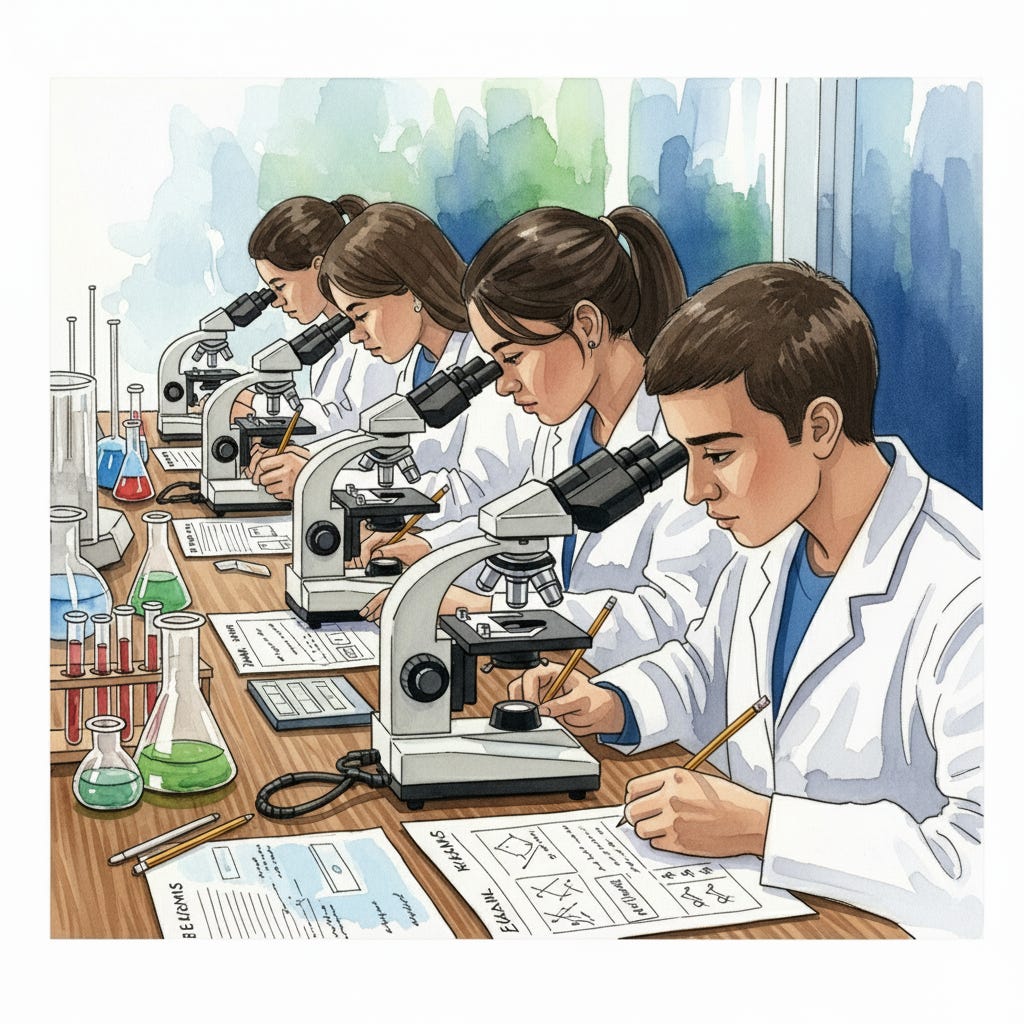
Microscopic anatomy exams were like educational musical chairs designed by someone with a particularly twisted sense of humor. Picture dozens of microscopes lined up on lab benches, each loaded with a slide containing cellular mysteries. Every five minutes, a bell would ring and we'd all shift one seat to the left, like the world's nerdiest game of Russian roulette.
You had five minutes to identify the tissue, understand its function, and answer questions that would determine whether you'd be explaining diseases to future patients or explaining to your parents why medical school didn't work out.
One examiner's twisted genius truly shone. Among the legitimate tissue samples, he'd slip in two biological practical jokes. The first was a slide with what looked like a chaotic mixture of tissues—muscle, fat, bone fragments, hair, skin, bits of intestine ;all jumbled together like a biological junk drawer.
My first thought: "This must be a teratoma, some kind of tumor." But we weren't being tested on pathology yet, so why would...?
That's when I did something that would horrify modern test-security protocols: I removed the slide from the microscope and looked at it with my naked eyes. The tissue sample was perfectly round, about the size of a nickel, and suddenly, the "predominance of muscle with fragments of fat, bone, hair, skin, and intestine" made perfect sense. Especially when I saw an insect part.
I was looking at a cross-section of a hot dog.
A hot dog. In a medical school exam. This examiner had literally turned processed meat into a teaching moment about critical thinking.
The second suspicious slide appeared to be embryonic tissue—another complex mixture that could have been some exotic tumor. Again, I removed the slide and examined its shape. It was clearly a section of a normal fetal foot, probably from the anatomy department's collection.
This experience was so formative that for the rest of my career, I always looked at slides carefully before placing them under the microscope. That simple habit saved me from embarrassment more times than I can count. But more importantly, it taught me something no multiple-choice question ever could: always question your assumptions, especially when something seems too convenient or too obvious.
A couple of years later, we faced the pathology oral examination or ‘viva’—an exam so feared that rumors about the external examiners circulated like ghost stories around a campfire. The most terrifying legend involved a professor from the University of Cape Town, identifiable by his shock of bright orange hair and matching eyebrows. The morning of the exam, we gathered in the pathology museum foyer like condemned prisoners. The departmental secretary sat behind a small table, class list in hand, assigning students to their fate with the cheerful efficiency of an upbeat executioner.
"Ah, Mr. Benjamin," she said with a warm smile designed to calm nerves that were already frayed beyond repair, "you go to table three."
I walked into the museum and immediately spotted table three. As I approached, my view was completely blocked by two enormous, bushy orange eyebrows that seemed to float independently in space. My sweat glands kicked into overdrive, and my heart rate jumped to cardiovascular workout levels.
Professor Becker—owner of the legendary orange pelage—sat behind a collection of glass bottles containing diseased organs and unidentifiable tissue fragments floating in formaldehyde. In front of him lay a small writing pad, visible to the student, with a pencil poised menacingly above it.
He pointed to the first specimen—a stag-horn shaped kidney stone nestled in a bisected kidney like some geological nightmare—and asked his question. I stammered out an answer.
His pencil didn't move.
Next question. This time, he drew a long, deliberate line on the paper.
That's when I realized the diabolical genius of his system: he was drawing a hangman. With each wrong answer, another element would be added to the gallows. If he completed the entire execution scene before the exam ended, you knew your fate was sealed.
Question after question, I watched that drawing evolve. A vertical post appeared. Then the horizontal beam. Each stroke of the pencil felt like a countdown to academic doom. Some students claimed this was valuable training for making decisions under extreme pressure—like preparing future doctors for life-or-death situations. Others called it psychological torture that probably violated several international conventions.
As I stood to move to the next section of the exam, I was relieved to see that the noose remained undrawn. I had dodged another academic bullet, but barely.
Modern American testing culture has created something unprecedented in human history: a generation of students who can perform academic tasks without actually engaging their brains. We've gamified learning to the point where students have become skilled at pattern recognition, test-taking strategies, and grade optimization—but they've never learned to think under pressure, defend their reasoning, or solve problems that don't come with multiple-choice options.
The "medieval" methods weren't torture devices designed by sadistic academics (well, mostly). They were sophisticated systems for developing mental resilience, creative problem-solving, and the ability to perform under pressure—skills that, coincidentally, turn out to be useful in real life.
When I was chasing that grasshopper across the laboratory floor, I wasn't just demonstrating my incompetence with insect handling. I was learning to adapt when my carefully laid plans went awry, to maintain composure under embarrassing circumstances, and to problem-solve in real-time.
When I was constructing my fake frog artery, I wasn't just cheating (well, I was a little). I was learning to think creatively under pressure, to improvise solutions when standard procedures fail, and to maintain quality standards even when things go wrong. Show me a multiple-choice question that teaches that kind of adaptability.
When Professor Orange Eyebrows was drawing his hangman gallows, he wasn't just terrorizing students for fun (though he probably enjoyed it). He was creating conditions where we had to access our knowledge while managing extreme stress—exactly the kind of situation we'd face in medical emergencies, difficult diagnoses, and life-or-death decisions.
Enter ChatGPT and its AI cousins, and suddenly our carefully constructed house of educational cards has collapsed. Students can now generate A+ essays, solve complex problems, and answer sophisticated questions without engaging their brains at all. They've become incredibly skilled at prompt engineering — the art of getting AI to do their thinking for them.
And we're shocked that students would use these tools when we've spent decades creating assessment systems that prioritize the right answer over the thinking process that leads to it.
The AI revolution has exposed something we should have noticed long ago: our modern testing methods were already teaching students to be sophisticated parrots. We were rewarding memorization over understanding, pattern recognition over critical thinking, and test-taking skills over actual learning. AI has simply become a more efficient parrot.
The solution isn't to ban AI or to develop better cheating-detection software (welcome to the eternal arms race between rule-makers and rule-breakers). The solution is to return to assessment methods that actually measure what we claim to care about: thinking, problem-solving, and the ability to perform under pressure.
Bring back the "medieval" methods. Return to oral examinations where students have to defend their thinking in real time. Create practical assessments where they have to solve problems with their hands and brains, not their internet connection. Design situations where they have to adapt when their carefully prepared answers don't fit the actual questions.
What we're really asking is for educators to work harder, to design more sophisticated assessments, and to actually engage with students as individuals rather than as data points in a standardized system. We're asking administrators to value learning over efficiency, understanding over convenience, and educational quality over budgets..
Most importantly, we're asking students to do something truly radical in 2025: to think for themselves, without digital assistance, while someone is watching and judging their performance in real time.
It sounds terrifying because it is. But that's exactly why it works.
Real learning has always been uncomfortable, unpredictable, and occasionally humiliating. It involves chasing grasshoppers across laboratory floors, constructing fake arteries when your real ones fail, and solving problems while orange eyebrows glare at you menacingly.
The medieval methods weren't perfect, and they certainly weren't always pleasant. But they produced something our modern system struggles with: students who could actually think, adapt, and perform when it mattered.
It’s time we started optimizing for competence, embracing the beautiful, messy, occasionally humiliating reality of genuine learning.
The real world doesn't come with multiple-choice options, and it definitely doesn't provide Wi-Fi when you're trying to save someone's life.
Welcome back to “medieval” education.
(https://www.nytimes.com/2025/08/26/opinion/culture/ai-chatgpt-college-cheating-medieval.html)
Excellent assessment of our current educational environment.