
On Being a Curmudgeon
The art of irony and ridicule

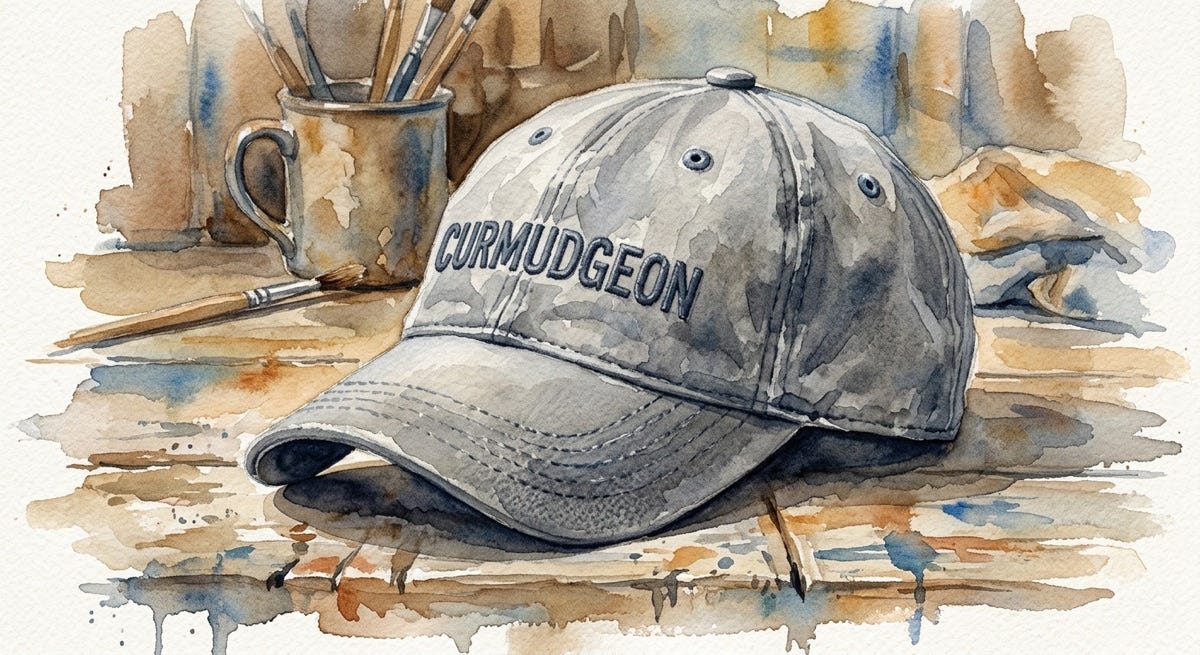
Being a curmudgeon is a lot like being Kermit the Frog: it’s not easy being green, and it’s not easy being disagreeable on principle. You stand apart from your tribe, viewed with the same warmth reserved for a health inspector at a food truck festival. You are the killjoy, the grouch, the spoilsport, a skeptic worse, a cynic. This is the word people use when they mean “someone who is annoyingly correct.” The traditional definition of a curmudgeon is a bad-tempered, stern old person, typically one who complains frequently and is easily annoyed by things like joy, small talk, and the sound of leaf blowers. The word’s origin is an unsolved mystery, first appearing in the 16th century and refusing to explain itself ever since. Early etymologists guessed it came from the French cœur méchant, or “evil heart,” which is a lovely theory undone entirely by the facts.
This classic definition, while accurate for the worst offenders, leaves out a whole population of us who are more nuanced grouches. My personal model is the late Andy Rooney of 60 Minutes. In that program’s heyday, we’d watch CEOs, senators, and assorted scoundrels squirm under a journalist’s cross-examination, and then, as a palate cleanser, Andy would spend five minutes explaining exactly why junk mail, or shoelaces, or the design of the modern jar lid was a moral outrage. He did it with such precision and dry wit that you forgave him for ruining jar lids for you permanently. He remains my inspiration for the sort of person who looks at the world, catalogs its flaws with the thoroughness of an IRS auditor, and then has the nerve to say so out loud.
Viewed this way, the curmudgeon is actually a hopeless romantic wearing a very convincing disguise. We have an intense, almost embarrassing desire to point out foibles, vagaries, duplicity, and dishonesty, all in the naive hope of making the world slightly less absurd and perhaps even a better place. The best do this with sarcasm, irony, parody, and wit, because turning outrage into a joke is cheaper than therapy and more socially acceptable than yelling. Unfortunately, in the United States, irony is treated the way a dog treats a card trick. It walks right past it, sniffs the air, and wanders off. Sarcasm fares little better. And ridicule, the curmudgeon’s favorite blunt instrument, tends to make its targets uncomfortable, which is the entire point.
Assailed by so much hypocrisy and maudlin sentimentality, the curmudgeon takes it as a sacred duty to maintain a state of perpetual, well-organized outrage. There is so much to debunk these days, what with social media, anti-scientific influencers, and an entire economy built on things that are fake — fake news, fake images, and, increasingly, fake people. And naturally, we get blamed for noticing. Point out that the emperor has no clothes and you’re not thanked for your keen eyesight; you’re accused of staring.
For those of you considering a career change into curmudgeonry, I have some reading recommendations to get you started. Begin with Hans Christian Andersen’s story of the little boy who points out that the emperor is, in fact, not wearing any clothes: the patron saint of every curmudgeon who ever opened his mouth at a dinner party he wasn’t invited back to. We would all be better served if a few more journalists had that boy’s courage and that boy’s willingness to state the obvious. It’s the founding myth of the profession, even if the protagonist technically fails to meet the age requirement.
A few books will round out your curmudgeonly education. Jon Winokur’s The Portable Curmudgeon and Andrew John and Stephen Blake’s Are You a Miserable Old Bastard? Quips, Quotes and Tales from the Eternally Pessimistic are two excellent bedside companions, best read in small, bitter doses, like espresso.
Perhaps the apotheosis of the form is Howard Jacobson’s Whatever It Is, I Don’t Like It. As the 2010 Man Booker Prize winner, Jacobson writes with a precision that makes his irritation feel less like complaining and more like scholarship. Reviewers have praised his sharp wit and confessional candor, and his gift for puncturing sanctimony and cultural foolishness wherever he finds it, which is everywhere. Definitely worth a read, ideally while nodding vigorously in assent.
Every calling needs its patron saints, and curmudgeonry has produced some of history’s finest. A brief, incomplete, and entirely biased tour:
W.C. Fields built an entire career on despising children, dogs, and sobriety, more or less in that order. Asked how he liked children, he is said to have replied that he liked them parboiled. A joke, one assumes, though he never seemed in a hurry to confirm it.
Dorothy Parker turned disappointment into an art form and could dismantle a bad play, a bad marriage, or a bad hat in a single sentence. “If you want to know what God thinks of money, just look at the people he gave it to.”
H.L. Mencken, the Sage of Baltimore, spent decades gleefully skewering politicians, preachers, and the American public’s taste in both. He defined a puritan as someone haunted by the fear that someone, somewhere, may be happy.
Winston Churchill could be devastating even in retreat. When a privileged woman (British MP Bessie Braddock or Lady Astor) accused him of being drunk, he reportedly agreed, adding that in the morning he would be sober and she would still be ugly — a rejoinder that has outlived the argument by about a century.
Fran Lebowitz, a contemporary standard-bearer, has made an entire public persona out of refusing to be impressed by anything invented after 1965. Her verdict on exercise: “the only reason I would take up jogging is so that I could hear heavy breathing again.”
George Carlin took curmudgeonry and gave it a philosophy degree. His observations on euphemism, advertising, and self-help culture remain so accurate that quoting him now feels less like comedy and more like citing a source.
What unites them all, and what I’d like to think unites the rest of us muttering into our coffee, is that the complaining was never really the point. The jokes were. The outrage was just the delivery mechanism for the truth, wrapped in enough humor that people would swallow it before they noticed what they’d been fed.
With all that said, it is perhaps no surprise that I became a pathologist. What other branch of medicine lets you spend your entire career examining other people’s mistakes, under a microscope, with nobody arguing back? Had I been an optimist, I would have become an orthopedic surgeon, cheerfully bolting people back together and believing every one of them would heal perfectly. Pessimism, on the other hand, was my stock in trade. It served me well, and it has never once let me down — which, come to think of it, is exactly the kind of thing a pessimist would be pleased to report.
First it took 3 tries to enter the ever changing codes. The phone feature is poor at best. Now…Andy Rooneys best show was when he emptied his kitchen utensil drawer and brought them to the show. I immediately threw out 20 articles but now I must revisit the 3 drawers full of dups.
Curmudgeonry today is quite challenging. I think this may be because so many people seem ready to take offense at the smallest perceived slight. For this reason I have moved my practice of the art to larger groups of people. Just the other day I was at a Nature Club meeting here in Sun City, Texas where I live with about 14,000 other 55+ people. The talk at the Living with Nature Series that day was about vultures and buzzards - (birds, not the folks in our Dell Webb community.) The speaker asked our audience if anyone knew why so many of these birds lived in Sun City? .(talk about teeing it up!). After about three seconds of contemplative silence I loudly spoke up: “0ld people?” The next four seconds were the longest of my life. Then everyone cracked up.