
Supplements — Redux
A crap-shoot

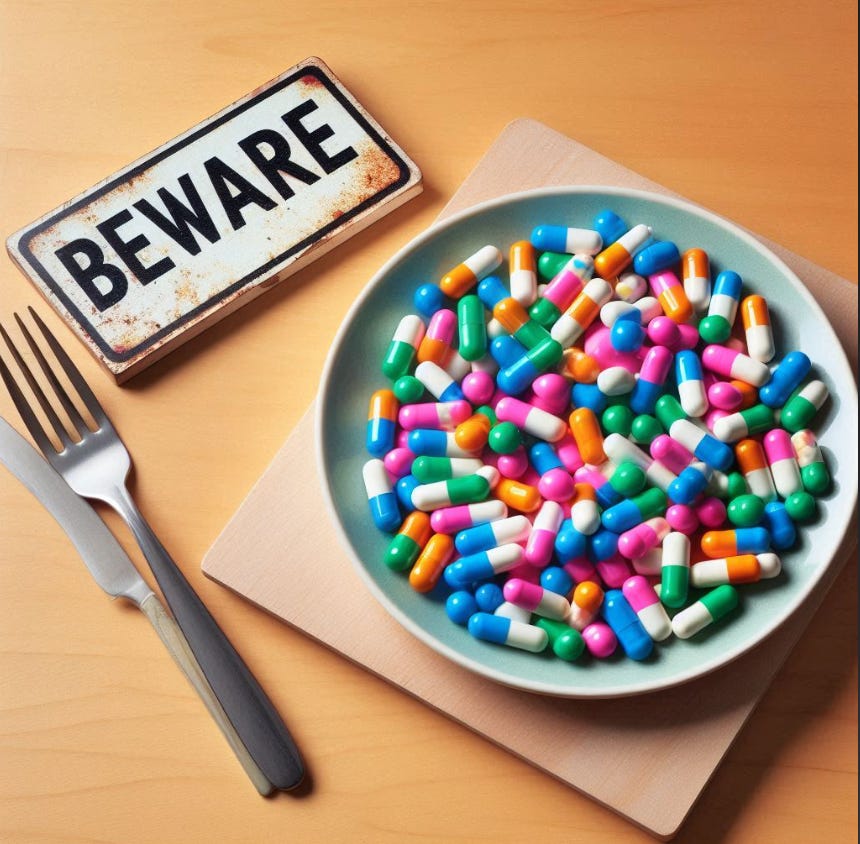
I’ve written about supplements before. More than once. And yet here I am again, because the situation keeps getting worse and the public keeps getting played.
The core problem with supplements isn’t whether they work, though that’s a legitimate question for most of them. The real problem is simpler and more embarrassing: you often have no idea what’s actually in the bottle. It could be the ingredient on the label. It could be rice powder. It could be something from the factory floor that you’d rather not think about. The industry operates with almost no meaningful oversight, a fact documented repeatedly by investigative journalists, the FDA, and anyone who’s bothered to look.
Let me tell you a few personal stories.
Forty years ago, while working in Chongqing and Shanghai, I first encountered red yeast rice. The claim was that it was good for cardiovascular health and lowered cholesterol. I was intrigued and, it must be said, not immune to the lure of a billion-dollar discovery. I brought home a bottle of capsules. My wife Vivien and I became the guinea pigs. I ran a clinical laboratory at the time, so cholesterol measurements were easy to arrange. We established our baselines, took a capsule daily for a month, and retested. Bingo. Both of us dropped our cholesterol levels by about 20%. I briefly imagined a very comfortable retirement.
On my next trip, I brought back a selection from several different manufacturers and ran the experiment again. This is where science has a way of humbling you. Over 50% of published studies can’t be replicated, and mine was no exception. Our cholesterol didn’t budge. I suspected inconsistent quality control: every batch from every manufacturer was probably different, with little or no standardization of the active compound. I couldn’t measure it directly, but the results spoke for themselves.I filed red yeast rice under ‘interesting but unreliable’ and more or less forgot about it.
A few years later, Big Pharma did what Big Pharma does. They identified the molecule, synthesized it, patented it, and made a great deal of money. You know it as statins. I had missed the boat.
Years later, a colleague mentioned he was taking a red yeast rice supplement instead of the proprietary medicine offered by the pharmaceutical companies. I knew that the FDA had mixed feelings about red yeast rice — specifically, that some preparations contained statin-like activity but hadn’t gone through the clinical testing or quality control required of actual pharmaceuticals. So I called the company, a well-respected national brand that made his capsules.
“I’d like to know the concentration of monocolin K in each capsule,” I asked the marketing manager. “It’s not listed on the bottle.”
She transferred me to production.
“I can’t give out that information,” the production chemist said.
“Is there any monocolin in it at all?”
“I can’t tell you that.”
“Will it lower my cholesterol?”
“I can’t tell you that either. But it may benefit your cardiovascular system. It’s been used in Asia for eons.”
For eons. That’s the standard of evidence we’re working with here.
Here’s the backstory. Monascus purpureus is the yeast cultured on rice that gives it a striking red color. It’s been part of Chinese cuisine and medicine for centuries. In the 1970s, researchers searching for cholesterol-lowering drugs isolated two promising compounds: a statin from Aspergillus (patented by Merck) and monacolins from red yeast rice. As it turned out, the two compounds were closely related, possibly identical.
The FDA’s solution to this awkward overlap was characteristically blunt: since red yeast rice was classified as a dietary supplement rather than a drug, it ruled that red yeast rice products could not contain meaningful quantities of monacolins. In other words, they made it illegal for red yeast rice to actually work. This triggered a string of lawsuits and regulatory skirmishes. Red yeast rice briefly disappeared from shelves, then quietly came back. There are now upwards of thirty brands available. Some contain active monacolins. Some don’t. The FDA issues warning letters to companies that cross the line, but only if it catches them, and only after the fact.
Here are the practical consequences for anyone trying to make an informed decision:
You have no idea whether your bottle contains any active ingredient.
If it does, you have no idea how much.
There’s no reliable information about contamination, such as heavy metals, or the mycotoxin citrinin that can show up in fermentation products.
No safety warnings, despite the fact that the active compound is essentially the same as lovastatin, with similar side effects at equivalent doses. There are documented cases of liver toxicity and muscle damage attributed to red yeast rice extracts. In China and Japan, where people eat the native red rice as food rather than swallowing concentrated extracts in capsules, the monacolins levels are low enough that serious side effects are rare. That’s not how we consume it here.
No reporting mechanism for adverse effects, because the product is theoretically illegal to sell with active ingredients anyway.
Labels that are technically accurate and substantively useless; ‘produced using traditional methods,’ ‘may support cardiovascular health.’
Now for a more recent story — as in, last week.
My wife and I came across a YouTube video by a physician recommending everyday foods to add to your diet as you age. One suggestion was to stir a small amount of Ceylon cinnamon into your morning coffee. It has insulin-like effects that could help regulate your blood sugar. Sounded harmless enough. Despite my skeptical scorn, I ordered some.
Two days later, I looked like I’d lost a fight. My skin was covered in ecchymoses — subcutaneous bleeds that produce large, spectacular bruises. I’m a pathologist. I recognized them immediately. I knew that regular cinnamon contains coumarin, a potent anticoagulant, the same class of drug used to prevent strokes in patients with atrial fibrillation, and also, charmingly, used as rat poison. Ceylon cinnamon is supposed to have much lower levels. This batch, it turned out, did not. The company confirmed a production failure.
Cinnamon. One of the most innocent substances imaginable. And it still managed to cause a problem, because no one was minding the production line.
So where does that leave us?
I can’t recommend red yeast rice as it’s currently produced and sold in the United States. The gap between what it could theoretically do and what any given bottle is likely to contain is simply too wide.
As for the rest of the supplement world, caveat emptor, as always. But also: caveat venditor. Someone should be watching these people. Isn’t one role of government supposed to be keeping us safe?
Selected references
Starr RR. Too little, too late: ineffective regulation of dietary supplements in the United States. Am J Public Health. 2015 Mar;105(3):478-85. doi: 10.2105/AJPH.2014.302348. Epub 2015 Jan 20. PMID: 25602879; PMCID: PMC4330859.1.
Endo A (October 2004). “The origin of the statins. 2004” Atheroscler Suppl 5 (3): 125–30.
https://skolfieldperformance.com/nutrition/the-reality-behind-supplements/#:~:text=Even%20when%20supplements%20include%20the,match%20what’s%20on%20the%20label.
https://www.health.harvard.edu/blog/whats-in-your-supplements-2019021515946
SoRelle R. Appeals Court says Food and Drug Administration can regulate Cholestin. Circulation 2000;102(7):E9012–E9013.
Heber D, Yip I, Ashley JM, et al. Cholesterol-lowering effects of a proprietary Chinese red-yeast-rice dietary supplement. Am J Clin Nutr 1999;69(2):231–6.
Gordon RY, Cooperman T, Obermeyer W, Becker DJ. Marked variability of monacolin levels in commercial red yeast rice products: buyer beware! Arch Intern Med 2010;170(19):1722–7.
Heber D, Lembertas A, Lu QY, et al. An analysis of nine proprietary Chinese red yeast rice dietary supplements. J Altern Complement Med 2001;7(2):133–9.
Liu BH, Wu TS, Su MC, et al. Evaluation of citrinin occurrence and cytotoxicity in Monascus fermentation products. J Agric Food Chem 2005;53(1):170–5.
Prasad GV, Wong T, Meliton G, Bhaloo S. Rhabdomyolysis due to red yeast rice in a renal transplant recipient. Transplantation 2002;74(8):1200–1.
Smith DJ, Olive KE. Chinese red rice-induced myopathy. South Med J 2003;96(12):1265–7.
Mueller PS. Symptomatic myopathy due to red yeast rice. Ann Intern Med 2006;145(6):474–5.
Warfarin-Wisconsin Alumni Research Foundation- made the University of Wisconsin, where I trained, a ton of money.