
The Seekers
A Field Guide to Those Who Cannot Simply Have Lunch

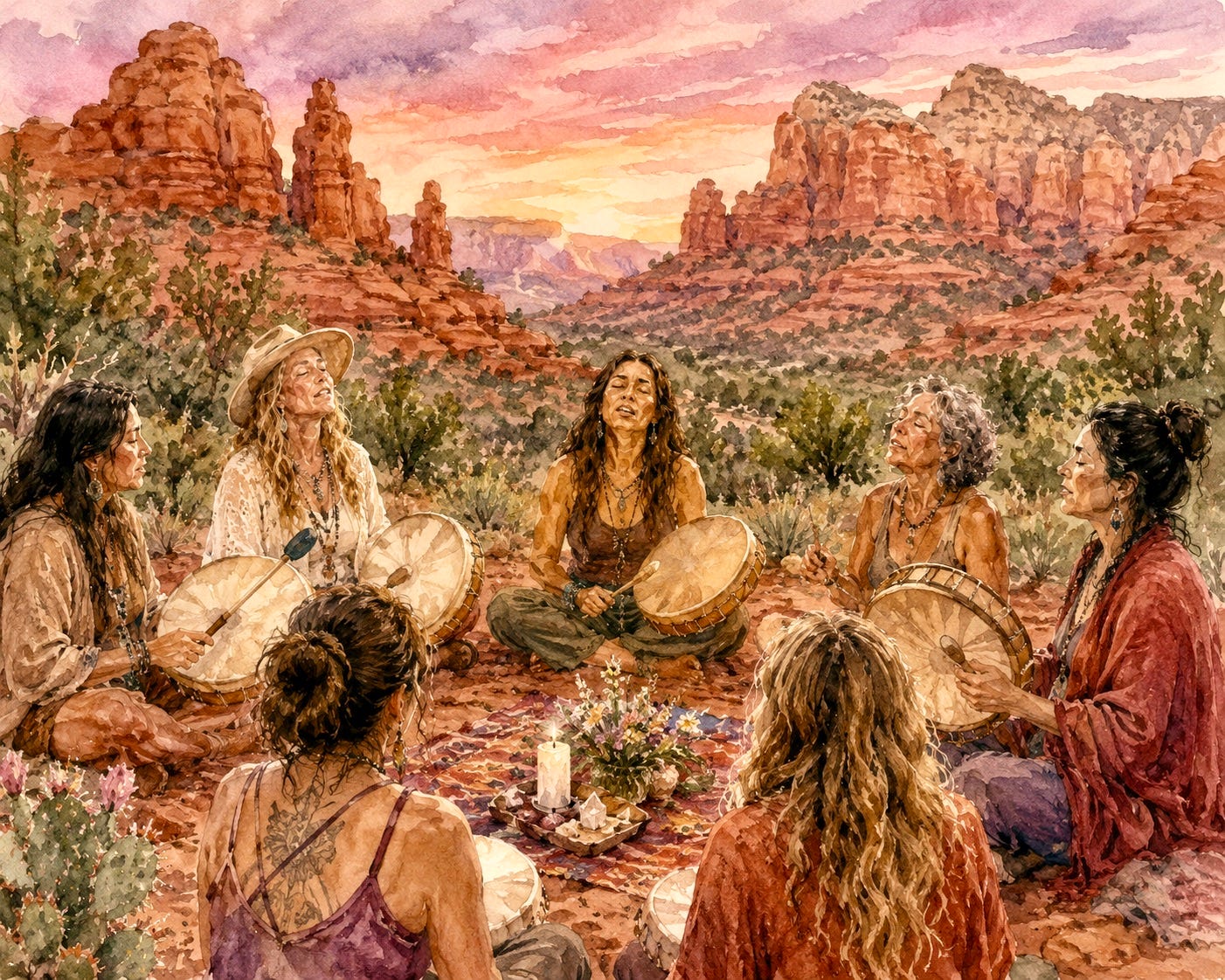
Why are we here? What is this all about? What is the sound of one hand clapping, and can it be heard in a yurt? These and similar existential questions have migrated from the dusty lecture halls of philosophy departments, where they belong, bothering no one, into the yoga studios, juice bars, and weekend retreat centers of comfortable middle- and upper-middle-class life. The philosophers are annoyed.
The people pursuing these questions are known as Seekers. They should not be confused with the merely curious, or the spiritually inclined, or the many daily yoga practitioners or even the garden-variety neurotic who just needs a decent therapist. The Seeker is a specific breed. They tend to have two X chromosomes, decent disposable income, a bookshelf groaning under titles like “The Untethered Soul” and “Women Who Run with the Wolves,” and an almost heroic resistance to the possibility that the answer might simply be that not everything has a meaning.
Men are not entirely exempt, of course. You will occasionally find a male Seeker, usually identifiable by his linen trousers, a man-bun, and a tendency to mention his vision quest at dinner parties. But they are a minority. The poor, for their part, are exempt by circumstance. They are too busy with the pressing question of rent and groceries. The devoutly religious already have their answer, helpfully pre-packaged and delivered weekly, and see no reason to outsource the project to a shaman in Sedona. And the practicing atheist finds the whole enterprise not merely unanswerable but vaguely irritating, like being asked to find the deeper meaning of a parking ticket.
The cottage industry that has sprung up to serve the Seeker is impressively creative. It is a marketplace of the metaphysical, a bazaar of the bewildered, and it can be expensive.
First, there are the Gurus. The guru’s primary qualifications are an air of serene certainty, flowing robes of natural fibers, and a willingness to pause meaningfully before speaking. Many are imports from the East, though a growing number are homegrown Americans named Brad or Heather who spent three weeks in Bali and came back transformed. The guru does not answer questions directly. The guru reflects questions back at you, which is either profound wisdom or a billing strategy, and possibly both.
Then there are the drugs. Not the recreational kind, you understand. This is serious spiritual pharmacology. Ayahuasca, the Amazonian brew that causes vomiting and hallucinations and is described by participants as “the most important experience of my life,” has become almost de rigueur in certain zip codes. Psilocybin mushrooms have been rebranded from “what college students eat before a Pink Floyd concert” to “a clinically supervised journey of inner healing.” MDMA, once known as Ecstasy and associated primarily with nightclubs, is now a tool of therapeutic breakthrough, which is at least an upgrade in setting if not in sobriety.
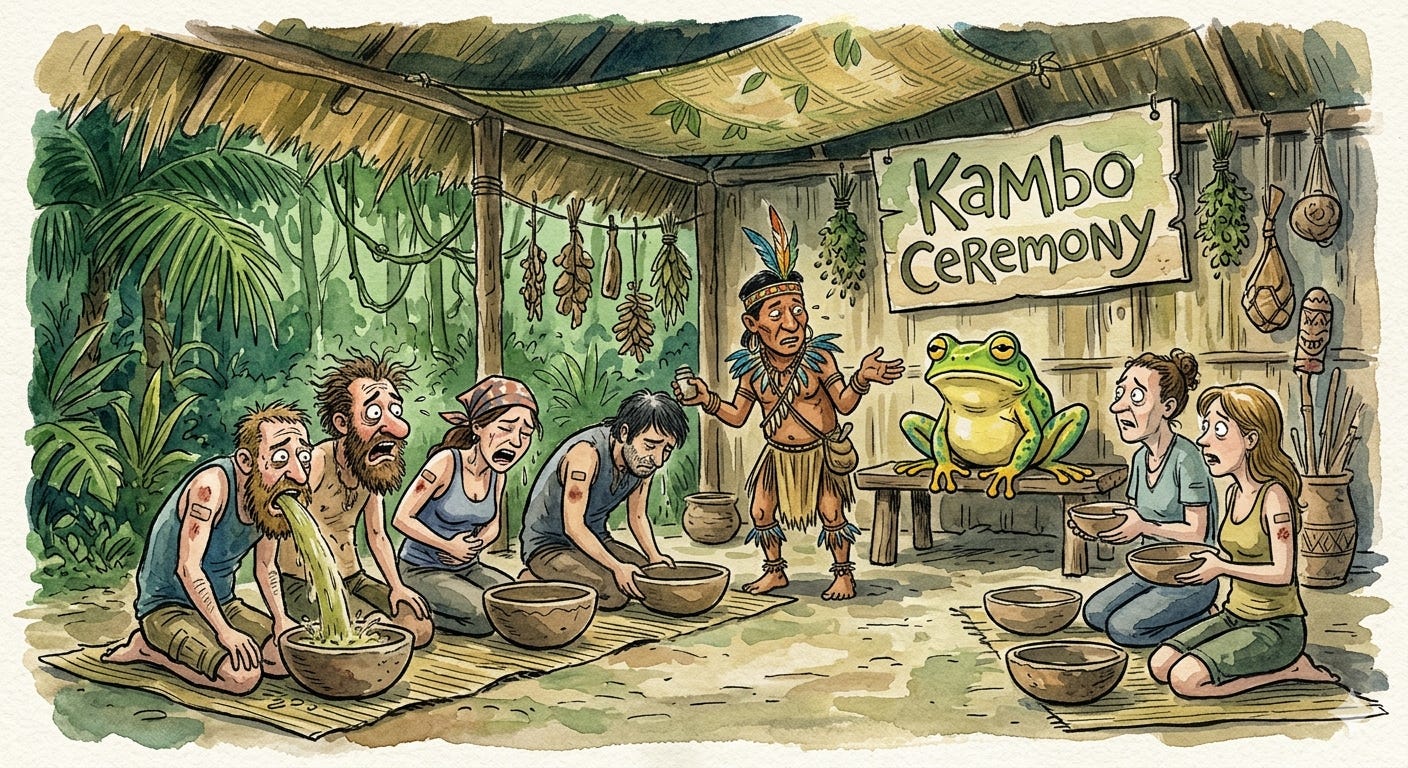
And then there is kambô. Kambô is the toxic secretion scraped from the skin of a Peruvian frog, the Phyllomedusa bicolor, if you want to be precise. You should want to be precise before you let someone burn it into your arm with a glowing stick. The immediate effect is violent illness. The promised long-term effect is purification. The rational observer’s reaction is: this is what happens when people have too much money and too little to do on a Saturday. Yet kambô ceremonies are sold out weeks in advance. The frog probably has mixed feelings.
There are also the retreats. The silent retreat, in which participants pay substantial sums to not speak to each other for a week, is a particular favorite. The appeal is that silence is clarifying. Equally clarifying, and considerably cheaper, is simply not talking for a while, but the retreat version comes with artisanal meals and a certificate. Other retreats involve sleeping outdoors, fasting, firewalking, sweat lodges, drum circles, and in at least one documented case, rebirthing; a process in which a grown adult is physically squeezed through a tunnel of bodies to simulate being born again.
The ancient wisdom industry also thrives. Seekers are voracious consumers of shamanism, indigenous ritual, astrology (a word that means “gazing at distant suns to understand why your mother didn’t validate you”), tarot, Human Design, Gene Keys, numerology, crystal healing, sound baths, and the I Ching. These traditions are drawn from cultures that, it should be noted, were dealing with rather more urgent problems than self-actualization. The Apache did not invent the sweat lodge so that a marketing executive from Scottsdale could find her authentic self. But here we are.
Santa Cruz, California, may be the Vatican of this movement. On a single block of its downtown, one can purchase an aura reading, consult a past-life regression therapist, book a session of craniosacral work, and pick up a crystal that has been charged under the full moon and infused with intentions. It has been said that in Santa Cruz, 50,000 counselors tend to 50,000 clients, forming a perfect closed loop of therapeutic codependence. Everyone is processing. No one is finished.
Tim Minchin, the Australian comedian and composer, delivered what may be the most efficient response to all of this in his 2013 commencement address at the University of Western Australia: “Don’t go looking for the meaning of life. There is none.” The address was nine minutes long (see YouTube video below). A weekend retreat covering the same ground costs $2,400, not including the frog. Why?
And why mostly women? This is the question that makes everyone nervous and therefore deserves to be addressed directly, with the full awareness that whatever is said here will be wrong in some circle somewhere. I trust that I will not lose half or more of my subscribers.
Traditionally, men found meaning in their work: building things, fixing things, competing with other men, and not examining their feelings too closely, which is its own kind of spiritual discipline. This arrangement worked reasonably well for them, if not for the people around them. Women, historically assigned the roles of caretaker, nurturer, and Keeper of the Emotional Ledger, had a rather different relationship to meaning. It was supposed to flow naturally from caring for others. And for many, it did.
But then women entered the workforce in numbers, took on careers, assumed leadership, and discovered that professional life, while satisfying in many ways, does not automatically answer the question “why am I here” any more reliably than domestic life did. Men, it turns out, weren’t finding profound meaning in quarterly earnings calls either; they were just too stoic or incurious to admit it. Women, having been trained from birth to process emotions, examine relationships, and ask difficult questions, simply applied those skills to the cosmos.
There is also the socialization hypothesis. Women are raised to seek connection, to ask how other people are feeling, to build community around vulnerability. The Seeker economy runs almost entirely on these instincts. The retreat is not just about enlightenment; it’s about shared experience. The drum circle is not only spiritual; it is intensely social. The women sitting in a circle at a plant medicine ceremony in New Mexico are, on one level, doing something ancient; on another level, they are doing the most female thing imaginable. They are sharing something deeply personal in a group setting, after making extensive preparations and bringing snacks.
Men, meanwhile, tend to pursue meaning in ways that don’t require sitting still and talking about it. They climb mountains, build boats, restore motorcycles, and coach youth soccer. These are not necessarily more effective paths to meaning. The garage at 11 p.m. and the yurt at dawn may arrive at equally inconclusive destinations, but they are quieter, messier, and cheaper. Nobody is charging a man $800 to sand a hull in search of his higher purpose, though arguably they could.
One further theory, offered cautiously: women are, on average, more comfortable with uncertainty, with process, with the idea that the journey is the point. This makes them both more suited to genuine philosophical inquiry and more susceptible to the charlatans who have noticed that “the journey is the point” is also an excellent way to sell an indefinite series of retreats.
What is most striking about the Seeker is that they never find what they are seeking. This is not a coincidence. It is the business model. If ayahuasca answered the question definitively, the retreat center would close. If the guru bestowed lasting clarity, the acolytes would go home. The Seeker economy depends on the answer remaining just over the next horizon, just past the next ceremony, attainable perhaps after one more year of study with a recognized master in a canyon somewhere in New Mexico.
The Seeker’s core conviction, stripped of all its beautiful language, is this: I was created for some higher purpose, and if I look hard enough and spend enough money, I will find it. This is a form of cosmic narcissism. The belief that the universe, in all its 13.8-billion-year indifference, organized itself around the question of what you specifically are meant to do with your one life. It is a charming belief. It is, however, a difficult one to sustain in the face of astronomy.
The rest of us, the non-Seekers, the muddlers-through, the people who find meaning in a good meal, a long walk, a child’s laugh, or the peculiar satisfaction of finishing a project, seem to get along adequately without resolving the question. We are not enlightened. We are not purified. We have not sweated in a lodge or wept in a circle or consumed anything secreted by an amphibian. We are simply here, which is, when you think about it, enough.
The Seeker would say we are missing something. They may be right. But we do have the weekends free to do things.
Boy are you going to piss a lot of people off! I skirted the edge of this seekerism for a while.