
The Sloth
A tourist mandate

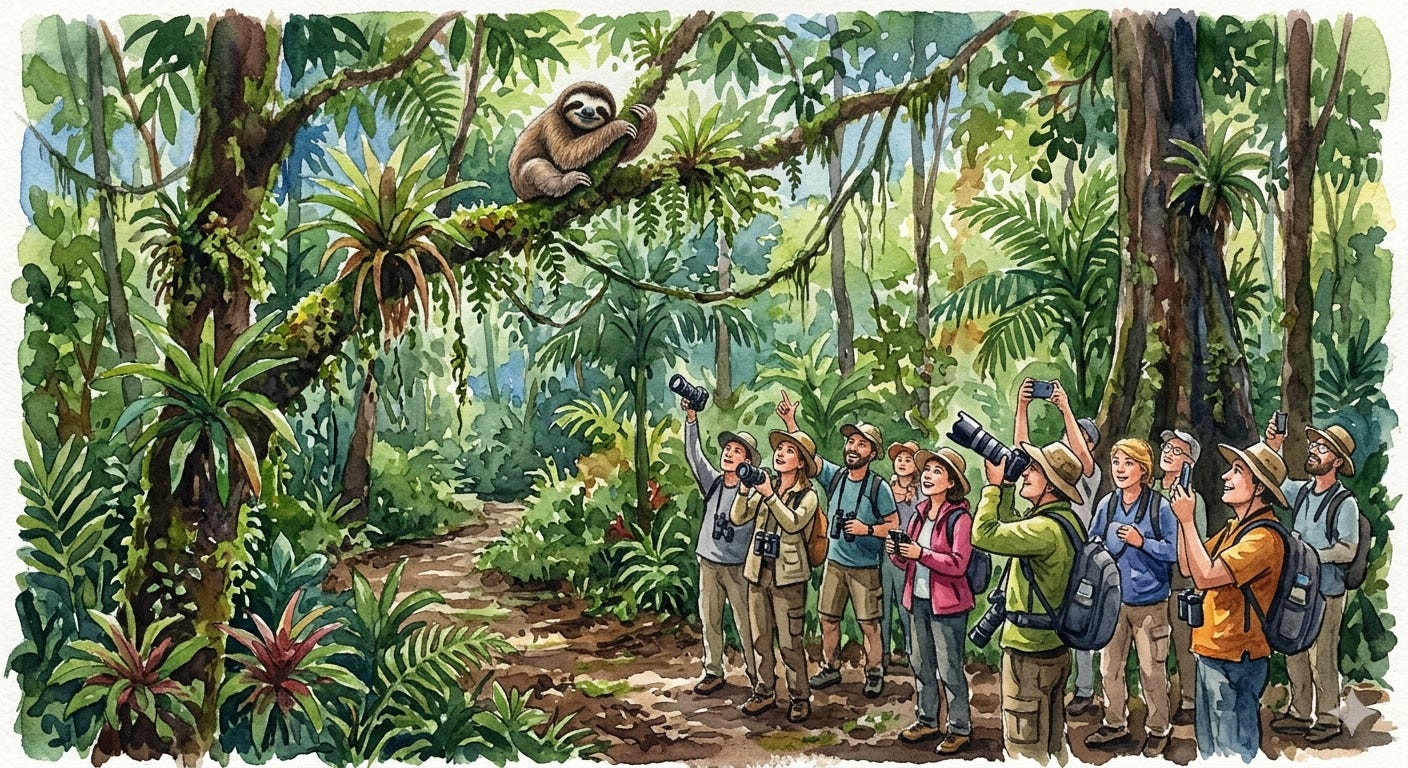
If you plan to visit Costa Rica, be warned: you will be expected to see a sloth. This is not optional. It is not a suggestion. It is a legal requirement enforced by the Costa Rican Ministry of Wildlife Compliance and Tourist Herding. You may not receive your exit permit unless you can provide sworn testimony that you have seen, or at least squinted meaningfully in the direction of a sloth. Even a blurry photograph is considered acceptable proof, which raises the obvious question: why is the photo blurry? The animal has not moved since the Pleistocene. It is, by every measurable standard, the most cooperative photographic subject on the planet. It will not suddenly bolt. It will not sneeze and ruin the shot. It will simply hang there, in serene, majestic, coma-like stillness, while the photographer captures a masterwork of motion blur that makes it look as if they were being chased by something.
This remains one of the great unsolved mysteries of ecotourism. It reminds me of my early days in China, when my hosts felt it was their patriotic duty to march me through every zoo in the country to visit the panda bears. Those furry ambassadors of Sino-American ‘friendship’. In retrospect, a ping-pong ball would have been a more honest symbol, given that the first real exchange between our nations involved their finely-tuned professionals casually defeating our enthusiastic amateurs. Those pandas were a sorry lot: dirty, listless, housed in enclosures that made the orphanages of Ceaușescu-era Romania look like a Sandals resort. But let us return to the sloth, which at least has the dignity of being miserable in the wild.
Why did this creature become the poster mammal for Costa Rica? I have genuinely no idea, and neither, I suspect, does Costa Rica. After all, it is no more than a brown-grey, motionless hair-ball wedged high in a Cecropia tree, visually indistinguishable from a termite nest, a wasp nest, or someone’s abandoned toupee. How this enigmatic lump was elevated to the same iconic status as the koala, the panda, and the polar bear defies rational analysis. At least those animals do things. The panda eats. The koala sleeps, admittedly, but does so with an air of intentionality. The polar bear actively menaces things. The sloth simply… persists.
There are two species, easily distinguished by mathematics, which is a sentence that has never before been written and may never need to be. One has two toes on each limb; the other has three. There is also a third variety that drains the lifeblood from many countries with enthusiasm. It has five toes and is commonly called a ‘politician.’ The first two subsist on a vegetarian diet, which the sloth’s entire physiology demonstrates as a warning against. Raw leaves are so nutritionally inadequate that the sloth has been forced by evolution to function at the metabolic level of a sluggish piece of furniture. Its internal organs are mainly dedicated to digestion, a process so laborious and multi-chambered it resembles less a stomach than a municipal sewage treatment plant. Therefore, there is very little room left for ambition.
Once a week, or thereabouts, assuming the animal is regular, which in fairness must be difficult to confirm, the sloth does something that is simultaneously heroic and baffling. It climbs all the way down from its tree to defecate and urinate on the ground. This is, as far as anyone can tell, the only time it makes contact with the earth’s surface. Scientists have proposed numerous explanations for this behavior, all of them imaginative, none of them convincing, and several of them frankly desperate. Perhaps it communicates territory. Perhaps it fertilizes its favorite tree. Perhaps it is simply the sloth’s one weekly commitment to being somewhere. The honest answer, which no one in academia is particularly eager to publish, is that we have absolutely no idea. The sloth is not telling. It descends, conducts its business with the grim efficiency of someone fulfilling a legal obligation, and laboriously hauls itself back up. None of this “passes the sniff test,” a phrase I selected with full awareness. In the meantime, speculation remains the currency of pseudoscience, and the sloth’s Wikipedia entry awaits your contributions. May I suggest “spiritual grounding ritual” or “weekly constitutional, taken very literally.”
The sloth is distantly related to the anteater, though the two appear to have gone in very different directions following their evolutionary split — the anteater toward frenetic, purposeful destruction, and the sloth toward something resembling a philosophy degree. Those long, sharp, formidable claws are not used for digging, but for clinging. The sloth grips its branch with the serene inevitability of a tenured professor gripping a grievance. It rarely falls, which is fortunate, because should a sloth infant slip from its perch, the mother’s calculus is disappointingly practical: retrieving the baby requires descending the tree, which requires energy, which requires more raw leaves, which requires more digestion time in the multi-chambered municipal sewage situation described above. The math simply does not work out. So the infant is left to the forest floor and its many enthusiastic recyclers. “Ach, shame,” as one might say in South Africa — or, in certain circles, “natural selection, respect the process.” And so, at this juncture in our sloth chronicle, we have thoroughly impugned politicians, vegetarians, and maternal devotion. A sacred trilogy, casually dismantled. The Sun City Curmudgeon regrets nothing.
But the sloth is not without its hidden depths, and here the story takes a turn into the genuinely extraordinary, or at least into the kind of facts that make you stop, stare into the middle distance, and quietly reconsider your assumptions about what constitutes a successful life strategy. Sloths, it turns out, are entire ecosystems unto themselves. Because they spend the majority of their existence inverted, their hair grows in the opposite direction from that of every other mammal on earth. This is, in itself, mildly interesting. What is genuinely astonishing is what lives in that hair. Bacteria. Fungi. Moths. Entire species of algae that have colonized the sloth so thoroughly that they turn its fur green, which serves as camouflage, meaning the sloth has outsourced even its own disguise to a sub-tenant. It is, in a very real sense, a landlord who has stopped trying. The moth, for its part, deposits its eggs in the sloth’s weekly ground delivery, and the larvae grow in the dung before flying back up to rejoin the fur. It is a complete ecosystem. It is also, depending on your sensibilities, either miraculous or profoundly upsetting. The sloth also sports an unusual number of cervical vertebrae: the two-toed variety manages with only six neck bones, while the three-toed has nine, which is remarkable given that virtually every other mammal on earth, from the shrew to the giraffe, has exactly seven. The sloth alone has decided that the rules do not apply. This is, one feels, entirely in character.
Sloth-spotting is the cornerstone of Costa Rican tourism. It occupies roughly the same cultural position as the Running of the Bulls in Pamplona, except the animal in question has not moved since Tuesday, and the only danger is pulled neck muscles from craning upward for forty-five minutes at what turns out to be a knot in a tree. When someone finally spots what may or may not be a sloth, the group falls into a collective delirium that is genuinely moving to witness. “Can you see it? Can you SEE it? Third branch from the right of THAT tree, not THAT tree, the other one, no, LEFT, your other left” — and then, as one, out come the Swarovski spotting scopes, the Leica binoculars, the Canon cameras fitted with lenses the size and apparent firepower of surface-to-air missiles. “I see it!” screams one triumphant participant, who is already mentally composing their Instagram caption and silently calculating the earliest possible flight home. During our last visit, I had to physically restrain myself from standing on a stump and announcing, “I have seen my sloth. My sloth has been seen. I am complete. I release you all.”
Perhaps the sloth ascended to stardom simply by being so thoroughly, magnificently bizarre. A creature assembled by committee from leftover parts with no clear mandate and extraordinary staying power. Or perhaps it is because, on those rare occasions when you are fortunate enough to glimpse its face, you find yourself staring directly at Chewbacca. Not a creature that resembles Chewbacca in a vague, impressionistic way. Chewbacca. George Lucas did not invent the Wookiee. He found one in a Cecropia tree in 1973 and pointed a camera at it, and the rest is cinema history.
As you will have gathered, the real reason everyone is required to see a sloth is not to see the sloth. It is to stand in humid bewilderment beneath a distant tree and contemplate what it means to exist. To truly, quietly, unhurriedly exist, without producing anything, achieving anything, or contributing to GDP in any measurable way. The sloth has mastered this. It has done so without effort, which is, if you think about it, the only way it could have done it. Whether this constitutes wisdom or a spectacular evolutionary miscalculation is left as an exercise for the reader. Of course, most people just want a selfie. The sloth doesn’t care. The sloth has never cared. And in a world that cares about everything constantly, at tremendous speed and volume, there is something almost admirable about that.
The Sun City Curmudgeon (he is not quite ready to imitate the sloth)