
When Labels Deceive
And Sometimes Lie

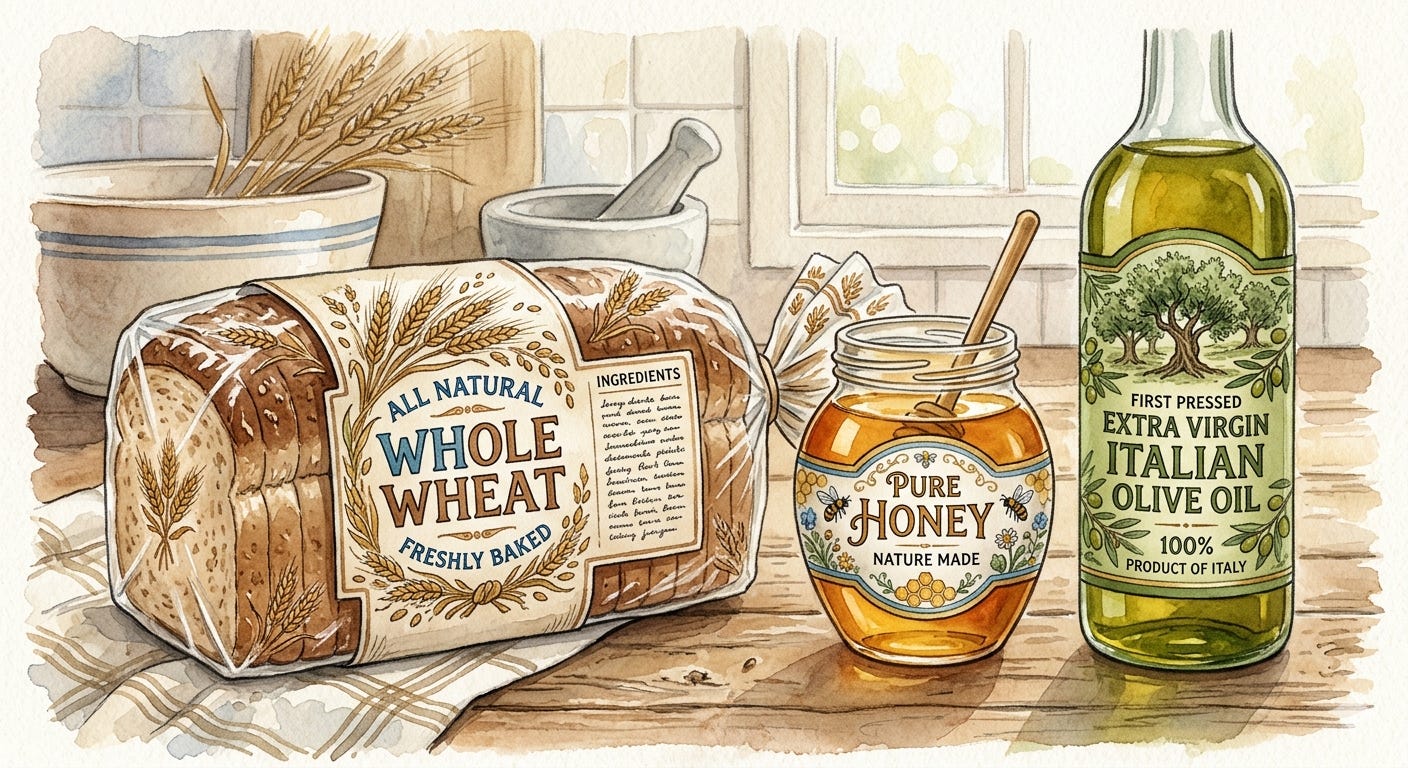
Months ago, I penned two posts about lies at restaurants and grocery stores. They covered the deception around eggs, meat, fish, and mushrooms. I thought I was done exposing all the marketing prevarications. Silly me. It turns out those were merely the most visible fraction, a small part of a larger issue. Just the beginning. So buckle up while I ruin another perfectly good day by demolishing some of your favorite products and pantry staples. The cunning subterfuge is actually awe-inspiring. A stint in the food marketing arena is an excellent prerequisite for anyone planning a later career in politics.
What is especially maddening is that when companies get called out for their bald-faced lies, even lose cases in court, they merely pay the fine and continue doing the same thing. It is regarded as the cost of doing business, and they pass the little extra cost on to the consumer. For them, it is a mere trifle. For us, it further erodes any remaining trust we have in corporations and our favorite brands. Think of it as a subscription service for disappointment, with automatic renewal.
Some of these deceptions appear subtle and have been so well engineered in food laboratories and factories that the average consumer might not detect the fakery. Or we become so inured to the fake products that, over time, we believe they are the real thing. This is not unlike how we eventually accept whatever indignity airlines inflict on us and call it “the flying experience.”
Let’s take butter. It has been around for millennia and should contain nothing more than cream and usually salt. After churning, the curds become butter, and the buttermilk is sold to those who like pancakes. Premium butters are allowed to mature and slightly ferment with lactic-acid-producing bacteria, resulting in a lightly tangy, rich flavor. Simple, ancient, and honest.
But scan the label on your standard American butter, and you will notice the phrase ‘natural flavors’ lurking there like a small rodent behind the refrigerator. That is the tip-off that what is in the package has been modified, optimized, and nudged toward tasting like butter without the inconvenience of being entirely butter. You may not detect the difference until you do a side-by-side taste test between a factory-made butter and an old-style European variety. The kind that arrives in a wrapper with a pastoral scene and a cow that looks unreasonably pleased with herself. Most of us opt for the cheaper ersatz version because our taste buds have been dulled by years of fast food, ultra-processed snacks, and airline pretzels. We have collectively lost the ability to identify what real food tastes like. It is a triumph of industrial ingenuity over sensory memory.
Far more dramatic than butter, however, is olive oil. It is the reigning champion of grocery store deception, a monument to the creative possibilities of fraud.
It is well known and repeatedly confirmed by investigative journalists, university food scientists, and at least one very irritated Italian senator that a sizable fraction of olive oils sold in the United States contains far more than actual olive oil. Sunflower oil, soybean oil, canola oil, and various other substances make cameo appearances in bottles adorned with images of Tuscan hillsides and old men who presumably pressed the olives themselves. They did not. The old man is a licensed photograph. The hillside is in Oregon.
In 2011, a landmark study by the University of California, Davis found that more than two-thirds of imported extra-virgin olive oils failed to meet the international standards for that designation. Extra-virgin, in the olive oil world, means the oil was obtained purely by mechanical means. No heat, no chemicals, no funny business, and it meets strict chemical and sensory standards. It is the olive oil equivalent of a notarized affidavit. But the fine for fibbing is modest, and the profit margin is generous, so the funny business continues at an industrial scale.
The “Product of Italy” label is a particular masterpiece of misdirection. It can legally mean the oil was bottled in Italy. The olives may have originated in Tunisia, Morocco, or Greece, been shipped to an Italian port, processed in an Italian facility for approximately forty-five minutes, and then emerged as a proud Italian product. In this scenario, Italy is less a place of origin than a finishing school.
Real extra-virgin olive oil should have a harvest date on the label, ideally within the past 12 to 18 months, since olive oil degrades over time. A fact the industry finds inconvenient to advertise. It should taste grassy, slightly peppery, and give you a faint scratch at the back of the throat. If your “extra-virgin” olive oil tastes like nothing in particular and slides down without protest, congratulations: you are drizzling flavored vegetable shortening on your salad. At premium prices.
If you want the real thing, look for oils from a single estate with a verifiable harvest date, preferably certified by the California Olive Oil Council or a credible European equivalent. Expect to pay considerably more. Weep briefly. Then enjoy the scratch.
HONEY is another natural product that has not been immune to the charms of food engineering. Various cheap sugars, high-fructose corn syrup, rice syrup, glucose syrup, and beet sugar in a trench coat are blended in after the honey is thoroughly ultrafiltered, a process that removes all pollen, all particulate matter, and all traceable evidence of geographic origin. What remains is a smooth, amber-colored sweetener that never crystallizes, never ferments, never does anything that real honey does, and cannot legally be verified as honey by any pollen analysis, because there is no pollen left to analyze. It is honey in the same sense that a parking lot is a forest.
The little bear-shaped bottle is a particularly effective piece of theater. Bears are associated with honey in the cultural imagination; Pooh, Paddington, and the general concept of natural abundance. The bear implies meadows. The honey implies bees. Neither implication is binding. Unless there is a verifiable code on the container ensuring the place of origin, such as a QR code linking to a specific apiary, the label is essentially a bedtime story.
Raw, unfiltered honey from a local beekeeper will crystallize in your cabinet within months. This is not a defect. This is honey behaving like honey. If your honey has sat in the pantry for two years in perfect liquid clarity, it is time to ask some questions.
BREAD has been the staff of life for ten thousand years. It is also, in its contemporary American supermarket form, one of the most elaborately disguised industrial products in your cart.
Let us begin with “whole wheat” bread, which has inspired more creative label writing than perhaps any other product outside of pharmaceutical marketing. Federal regulations require only that a product contain some whole wheat flour to call itself whole wheat. Not a majority, not a plurality, just some. Enriched white flour can constitute the bulk of the loaf, with whole wheat flour added as a nutritional garnish, much the way a sprig of parsley dresses up a plate of nachos. The bread is then colored a reassuring shade of brown with caramel coloring or molasses, because consumers associate brown bread with wholesomeness in a Pavlovian response that the industry has spent decades cultivating.
“Multigrain” is even more freewheeling. It means the bread contains multiple grains. Those grains can all be refined to within an inch of their nutritional lives. A bread could contain twelve different grains, all stripped of fiber and nutrients, and still wear the multigrain label like a merit badge. The seeds sprinkled on top are largely decorative, a kind of edible confetti.
“Made with whole grains” is the subtlest of the three and may be the most inspired. It commits to nothing. A single oat flake somewhere in the production facility, at some point during the manufacturing process, technically satisfies this claim. Legal, defensible, and a masterpiece of minimalist honesty.
Then there is the bread improver situation. Modern commercial bread is baked fast, sometimes in under two hours from flour to shelf, compared to the twelve or more hours traditional bread takes to develop flavor and structure. To compensate for the flavor that time would have provided, manufacturers add dough conditioners, emulsifiers, enzymes (listed as “processing aids” and therefore not required to appear on the label in some jurisdictions), and a range of additives that ensure the loaf stays soft and squishy for ten days. The ingredient list on a standard sandwich loaf now routinely runs to twenty or more items. For a product whose essential recipe is flour, water, yeast, and salt. Four ingredients. Humankind managed fine for centuries.
The artisanal bread movement, the sourdough revival, the long-fermented loaves, the bakeries that smell like actual bread,is, in part, a quiet rebellion against all of this. It is also, inevitably, being co-opted. Several supermarket chains now sell “artisan” bread baked in centralized facilities and trucked to stores. The word “artisan,” like “natural,” has no legal definition in food labeling. It means whatever the marketing department needs it to mean today.
PARMESAN cheese, or more precisely, Parmesan-style cheese, is worth a brief mention. In 2016, the FDA found that a major producer of pre-grated domestic Parmesan was including cellulose, a wood pulp derivative used as an anti-caking agent, at levels well above industry norms. The company settled. The product remained on shelves. Authentic Parmigiano-Reggiano, produced under strict Italian regulations and aged for a minimum of 12 months, contains only two ingredients: milk and salt. The real stuff does not require wood pulp. If you are grating your own from a wedge, you are ahead.
Fruit juice deserves a passing comment. “Made with real fruit juice” means, at minimum, that some real fruit juice was involved. How much is unspecified. The rest can be water, sugar, and artificial flavor. “100% juice” sounds unimpeachable until you notice “from concentrate” in smaller print. Juice that has been heated, stripped of flavor compounds, reduced to syrup, shipped internationally, reconstituted with water, and then had some of those flavor compounds added back in. It is juice, just as a powdered egg is an egg. Technically true. Experientially different.
Maple syrup is the honey situation in a different bottle. Pure maple syrup requires only one ingredient: boiled-down maple sap. “Maple-flavored syrup” and “pancake syrup” contain very little maple. They are corn syrup with artificial maple flavoring. Mapeline is a laboratory-created substance that approximates what forty gallons of sap, boiled down to one gallon, actually tastes like. It is a reasonable facsimile in the same way that a photocopied Rembrandt is a reasonable facsimile. Fine from a distance. Somewhat diminished on reflection.
None of this is secret. The information is available in academic journals, investigative reporting, court filings, and the fine print on the labels themselves, if you bring reading glasses and infinite patience to the supermarket. The challenge is that the system is designed to reward the appearance of transparency while minimizing its substance.
The most reliable defense remains tediously simple: shop the perimeter of the store, where the food that does not require twelve lines of ingredients tends to live. Read labels as a matter of habit, focusing not on the front panel claims, which are marketing, but on the ingredient list, which is at least nominally regulated. Buy from producers whose practices you can trace, however imperfectly.
Perhaps most importantly: be suspicious of any food product whose label tries to convince you it is something. Real butter does not need to tell you it is natural. Real olive oil does not need a Tuscan hillside. Real bread lists four ingredients and is done. The louder the label, the more it is compensating for something. In food, as in politics, the most trustworthy voices are usually the quietest ones.
Try again-perfect
Perfy