
Why are there not more car accidents?
Demolition derby avoided

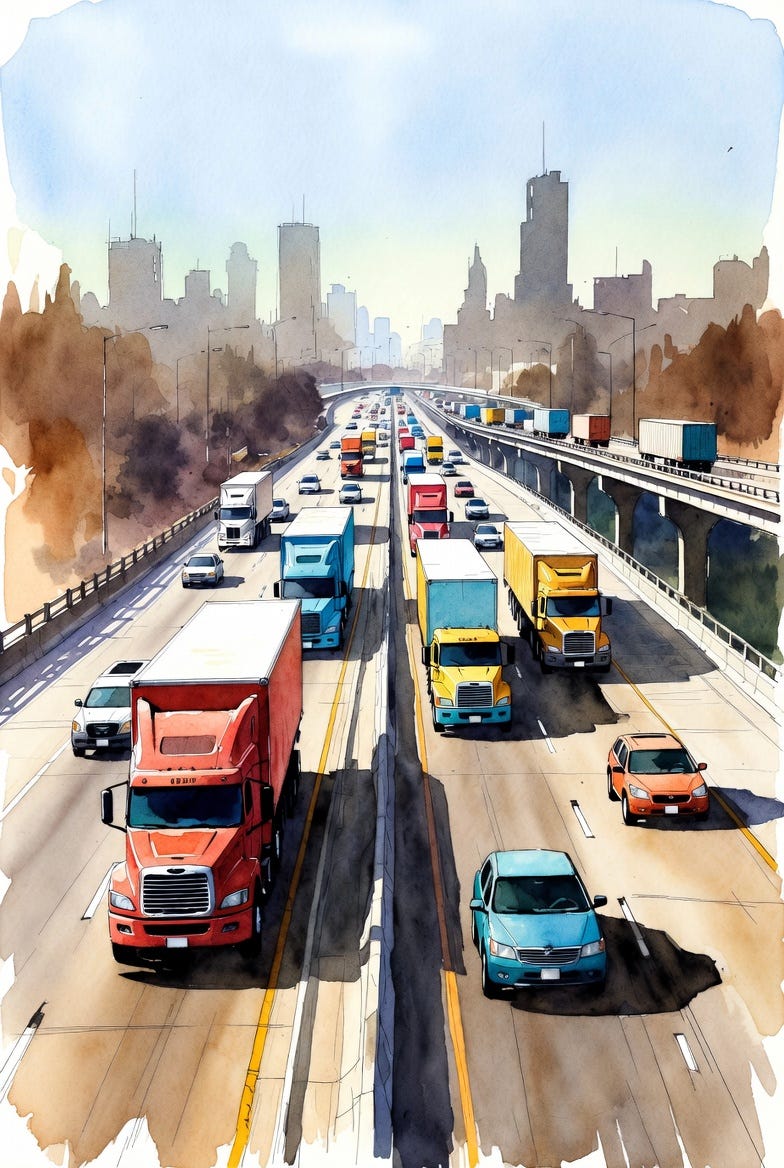
I was recently driving down Interstate 35 between Austin and the Dallas/Fort Worth Metroplex. A three-hour trip from hell. It rivals I-405 in Los Angeles, I-95 on the East Coast, I-4 in Florida, and I-5 in Seattle for being a soul-destroying experience. For much of the way, two lanes are fully occupied by trucks and eighteen-wheelers, leaving the far left lane for personal cars. These weave in and out, jockeying for the occasional advance of one vehicle. The remarkable thing is that this is all going along at 70 to 80 miles an hour, unless you are at a complete standstill. And that got me thinking. Why are there not more car crashes?
If you stop to think about it, it’s almost miraculous that we make it home every day. Tens of millions of us hurtle down narrow lanes of asphalt at seventy miles an hour, separated from oncoming traffic by a thin stripe of paint, and somehow it works. This is the automotive equivalent of “thoughts and prayers.” The real question is not why there are so many car accidents, but why there aren’t far more.
At any given moment, a disturbingly large percentage of people behind the wheel are operating at less-than-peak performance. Consider the roster of the road-weary. The National Highway Traffic Safety Administration estimates that about 1–2 percent of nighttime weekend drivers are legally intoxicated, and roughly 10 percent admit to occasionally driving after drinking. Another 20–25 percent of drivers have drugs in their system, from antihistamines and antidepressants to marijuana or painkillers, which dull reaction times. Essentially, a significant portion of America is driving while battling the pharmaceutical urge to take a nap.
Fatigue is even more common. Surveys suggest 40 percent of adults have driven while dangerously drowsy, and 15–20 percent of all crashes involve a tired driver. Being awake for 20 hours has the same effect on your driving as being legally drunk. So half of us are literally driving like drunk people, just without the fun of happy hour first.
Add to that the 9–10 percent of motorists who are actively distracted by phones, music, or the touchscreen dashboard at any given second. Meanwhile, around 25–40 percent of drivers report feeling stressed, angry, or preoccupied with work or family problems while driving. Roughly 15 percent cope with medical or cognitive issues that can impair perception or alertness. Approximately one in eight vehicles on the road has mechanical problems that could compromise braking or steering. Not only is the driver questionable, but the car itself might be held together by duct tape and optimism.
If you factor in overlap—many people are simultaneously tired AND medicated, or distracted AND stressed (multitasking)—it’s plausible that 60-70% of all drivers are operating below their optimal mental or physical state on any given day.
Then there is the reality that, by definition, half the population has an IQ below 100. We share the road with a diverse range of abilities, judgments, and temperaments. It’s a wonder of social coordination that traffic functions at all.
So why don’t highways resemble demolition derbies? The answer lies in the interplay between automatic human behavior and the system’s design.
First, much of driving is reflexive. Once learned, it moves from conscious reasoning to muscle memory. Eye-tracking studies show that experienced drivers rely on visual flow and peripheral cues to maintain their lane position and distance, even when their minds wander. In other words, our reflexes often take over when our attention wanders.
Second, the road system itself is built to forgive human error. Thank goodness for engineers who assumed we’d all be terrible at this. Lanes are wide, curves banked, and intersections engineered with generous sight lines. Rumble strips jolt a drowsy driver awake. Guardrails, airbags, and anti-lock brakes convert what could be fatal mistakes into survivable ones. Newer cars automatically brake or steer to avoid collisions their drivers never saw coming.
Third, traffic behaves as a self-organizing network. When one driver brakes suddenly, others adjust in milliseconds, creating a wave of responses that absorbs the error. In effect, every driver is constantly correcting not only for their own misjudgments but for everyone else’s. This creates that wonderful accordion effect we all know and love, where one person tapping their brake at 11:00 AM causes someone 3 miles back to come to a complete stop by 11:03. All it takes is one person to touch the brake, thinking that they saw a squirrel, and suddenly we’re all participating in an involuntary meditation on patience.
Finally, people subconsciously compensate for their own impairment. A tired driver may slow down. An older one like me avoids night driving if possible. Even risky behavior has boundaries shaped by self-preservation. Most of us flirt with danger but rarely cross its threshold.
It’s tempting to say our reflexes “override” our concentration, and in some ways they do. The brain’s sensorimotor circuits react to motion and threat far faster than conscious thought can.. While texting or fatigue can extend that delay, the body’s built-in survival mechanisms still offer a buffer against catastrophe.
Driving is a strange blend of the deliberate and the instinctive: an activity that demands focus, yet most people perform in a semi-automatic trance. We have designed our machines and roadways to accommodate that paradox.
Approximately 6 million crashes occur in the United States each year. That sounds enormous, until you realize Americans collectively drive more than 3 trillion miles annually. Statistically, that’s roughly one crash for every 500,000 vehicle-miles. Most end in minor fender-benders. Fatal collisions number around 40,000 per year, tragic but remarkably low considering the scale of exposure.
Traffic safety is not only a matter of individual discipline, but also a collective, adaptive ecosystem. We should curb texting, drunk driving, and road rage. We should recognize how remarkably resilient the system already is. A network that continuously compensates for human frailty.
In the end, we survive the commute not because we’re all vigilant geniuses (we’re demonstrably not), but because reflexes, technology, and the social choreography of the road work together in beautiful, chaotic harmony.
It’s less “everyone’s an excellent driver” and more “we’ve built a system that’s really, really good at keeping barely-competent humans alive.”
Given how many drivers are impaired, distracted, or simply average, the rate of survival borders on astonishing. The modern traffic system, for all its flaws, is one of humanity’s engineering triumphs: a fragile choreography of millions of imperfect participants performing almost flawlessly.
Author’s note: Writing this essay has made me significantly more anxious about driving. But at least now, when I’m stuck in traffic, I can appreciate that everyone around me is ALSO a barely-functional disaster, and we’re all somehow making it work together. There’s something weirdly beautiful about that.
I remember your telling me that in Chile.
My closest Seattle friends followed their daughter to New Zealand after she married a Kiwi. Traffic was one of the major reasons that made their decision to leave easy.
Honestly, the primary reason that I moved away from cities 44 years ago was traffic. My home is halfway between Denver and Albuquerque.